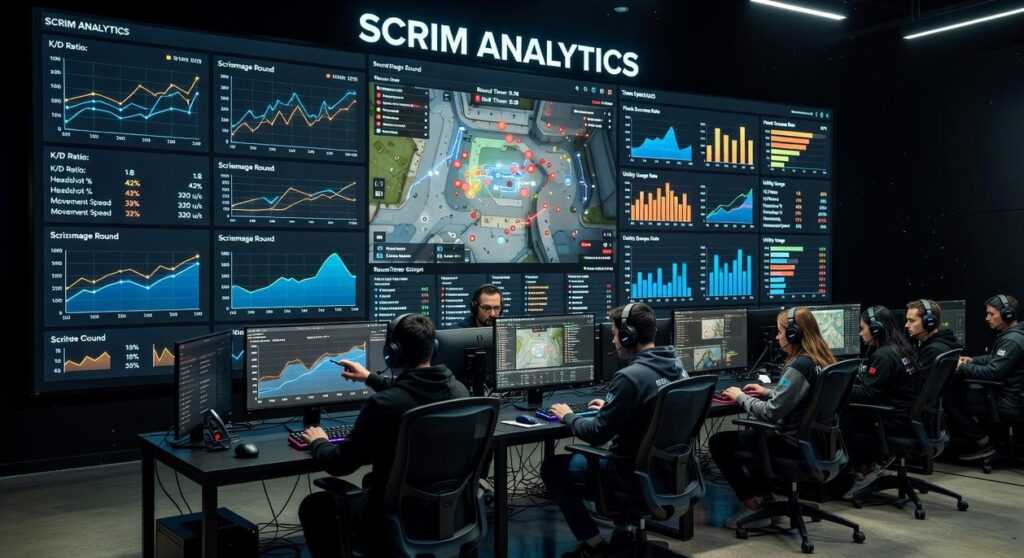

The Gamer’s Toolkit: How to Collect and Aggregate Your Performance Data
If you want to climb ranked consistently, you need more than good aim—you need data. Think of this as building your own control panel (yes, like Tony Stark, but for ranked).
Leveraging In-Game Replay Systems
Start with built-in replay tools in League of Legends, Valorant, or CS:GO. These systems let you rewatch matches, slow down key fights, and track metrics like KDA (Kill/Death/Assist ratio), GPM (Gold Per Minute), and utility usage. The benefit? Immediate feedback without extra software. For example, if your GPM drops at 15 minutes, you can pinpoint whether it was poor wave management or a bad rotation. Pro tip: Pause every death and ask, “What information did I ignore?”
Third-Party Analysis Platforms
Next, tools like Mobalytics, Blitz.gg, and Valorbuff automate data collection and compare your stats to players at your rank. That comparative edge is huge—you’ll see if your headshot percentage or vision score is actually below average (and by how much). This is where esports performance analytics shines, translating raw numbers into improvement plans.
The Power of Manual VOD Review
However, numbers lack context. Watching your own VODs explains the “why.” Did tilt affect your positioning? Did you overpeek? Stats flag the issue; VODs reveal the habit.
Creating a Performance Spreadsheet
Finally, track personal goals in a simple spreadsheet. Maybe you’re focusing on reducing early deaths or improving objective control. Over time, patterns emerge—and measurable progress keeps motivation high.
The Analysis Framework: Turning Raw Data into Dominant Strategy

Raw stats don’t win games. Interpreting them does. So let’s break this down into a clear, repeatable system.
Step 1: Establish Your Baseline
First, play a controlled sample of 10–20 games. This creates a baseline—your average performance across key metrics like GPM (Gold Per Minute), DPM (Damage Per Minute), Vision Score, and KP% (Kill Participation Percentage, or the percentage of team kills you’re involved in).
Think of this as your “normal.” Without it, you’re guessing (and guessing is not a strategy).
Step 2: Identify Patterns in Wins and Losses
Next, compare your wins to your losses. Do you consistently win when your Vision Score exceeds 1.5 per minute? Do losses correlate with low early-game GPM?
This is where patterns emerge. And patterns, unlike hunches, are measurable. (Yes, even if it “felt winnable.”)
Step 3: Correlate Metrics to In-Game Events
Now connect numbers to moments. A spike in DPM might align with a successful Baron fight. A low KP% could signal weak map rotations—meaning you weren’t present for critical engagements.
In esports performance analytics, this correlation step separates casual review from strategic refinement.
Step 4: Formulate Actionable Hypotheses
Turn insights into testable statements. Example: “If I die more than three times before 10 minutes, my win rate drops. Hypothesis: Improve early-game positioning to increase win rate.”
A hypothesis is simply an educated, testable assumption.
Step 5: Test and Iterate
Finally, adjust one metric at a time and track results. This creates a feedback loop.
Pro tip: Change only one variable per test cycle. Otherwise, you won’t know what actually worked.
For structured team systems, review frameworks used in developing grassroots esports programs for schools and universities.
And then repeat. Because dominant strategy isn’t built in one match—it’s engineered over many.
Stop Playing, Start Competing
You came here because you’re tired of hovering at the same rank, putting in hours without seeing real progress.
Now you have a complete framework for breaking that cycle. You understand how to analyze your gameplay, spot weaknesses, and eliminate them using hard data instead of guesswork. The frustration of feeling “stuck” is replaced with a clear, measurable path forward.
This is where most players fall short. They grind more games instead of fixing the right problems. A methodical system rooted in esports performance analytics removes emotion from the equation. It tells you exactly what to improve and ensures your practice time creates maximum impact.
Here’s your move: Pick one metric—GPM, Vision Score, or KDA efficiency—and make it your only focus next session. Track it. Improve it. Repeat.
Stop playing casually. Start competing with data.
 Gaming Rig Optimization & Tech Innovation Specialist
There is a specific skill involved in explaining something clearly — one that is completely separate from actually knowing the subject. Joana Dillardoniel has both. They has spent years working with tech-powered gaming innovations in a hands-on capacity, and an equal amount of time figuring out how to translate that experience into writing that people with different backgrounds can actually absorb and use.
Joana tends to approach complex subjects — Tech-Powered Gaming Innovations, Expert Tutorials, World-Class eSports Frameworks being good examples — by starting with what the reader already knows, then building outward from there rather than dropping them in the deep end. It sounds like a small thing. In practice it makes a significant difference in whether someone finishes the article or abandons it halfway through. They is also good at knowing when to stop — a surprisingly underrated skill. Some writers bury useful information under so many caveats and qualifications that the point disappears. Joana knows where the point is and gets there without too many detours.
The practical effect of all this is that people who read Joana's work tend to come away actually capable of doing something with it. Not just vaguely informed — actually capable. For a writer working in tech-powered gaming innovations, that is probably the best possible outcome, and it's the standard Joana holds they's own work to.
Gaming Rig Optimization & Tech Innovation Specialist
There is a specific skill involved in explaining something clearly — one that is completely separate from actually knowing the subject. Joana Dillardoniel has both. They has spent years working with tech-powered gaming innovations in a hands-on capacity, and an equal amount of time figuring out how to translate that experience into writing that people with different backgrounds can actually absorb and use.
Joana tends to approach complex subjects — Tech-Powered Gaming Innovations, Expert Tutorials, World-Class eSports Frameworks being good examples — by starting with what the reader already knows, then building outward from there rather than dropping them in the deep end. It sounds like a small thing. In practice it makes a significant difference in whether someone finishes the article or abandons it halfway through. They is also good at knowing when to stop — a surprisingly underrated skill. Some writers bury useful information under so many caveats and qualifications that the point disappears. Joana knows where the point is and gets there without too many detours.
The practical effect of all this is that people who read Joana's work tend to come away actually capable of doing something with it. Not just vaguely informed — actually capable. For a writer working in tech-powered gaming innovations, that is probably the best possible outcome, and it's the standard Joana holds they's own work to.